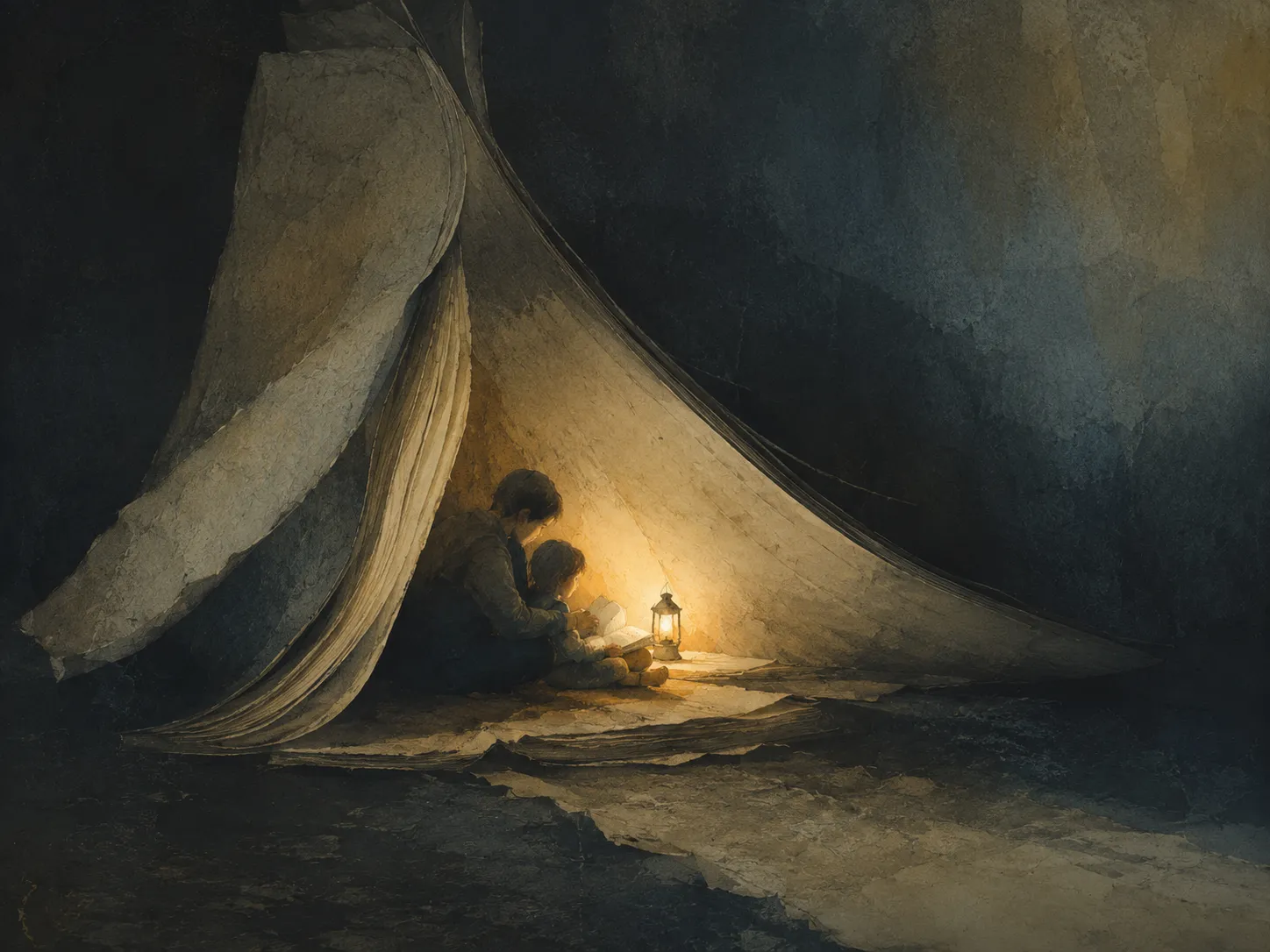


First in a series on Chuck McGill from Better Call Saul. Before any of the labels, there’s a boy in a tent, reading by lantern light, already unmistakably himself.
The lantern is the only light. Two brothers are in a tent, and the older one is reading out loud.
There is not much scene here, honestly. Most viewers would file it away as a warm older-brother moment and move on. That reading is not wrong. It is just not the only thing the scene gives us. The episode opens with a childhood flashback: two brothers in a tent, one reading aloud, the other becoming frightened by the story. The younger brother asks whether the girl in the story will be okay. Chuck responds not by exploring Jimmy’s fear, but by trusting the structure of the story itself.
The scene is a flashback. It opens “Lantern,” the tenth and final episode of Better Call Saul’s third season, and one of the last times Chuck stands at the center of the show. If you know the show, this may seem like an odd place to start. Spoilers for Better Call Saul follow. The series could have introduced us to Chuck as a child in a dozen ways. It chose to open one of its darkest, latest Chuck episodes with this: two brothers, a lantern, and a children’s adventure story. We are going to take the hint and start where Chuck starts.
It seems so minimal, almost like a throwaway line, but the exchange is doing more than calming a scared kid.
Jimmy is frightened by a story. There is no wolf in the tent, only a sentence Chuck is reading aloud, and Chuck is not frightened at all. He is in no hurry to rush past the scary part.
When Jimmy asks for comfort, note where Chuck goes to find it. He does not meet the fear. He does not say “I know, it’s scary,” does not ask Jimmy what’s frightening him, does not sit in it with him for even a beat. He answers first with certainty that the girl will be fine, and when that is not enough, with a method: keep reading. The comfort he offers is not “you’re safe.” It is “the story knows where it’s going, and so do I.” Trust the sequence. The answer is already written a few pages ahead, and the way to stop being afraid is to keep reading until you reach it.
That is a steadying thing to hand a scared kid, and it works. It also tells us something about Chuck. When the fear comes, he reaches for what he knows instead of what he feels.
Chuck is fourteen years old.
Fourteen is not usually an age famous for calm authority. Kids that age are often more reactive, more easily thrown, more interested in testing whoever claims to be in charge. Chuck is doing almost the opposite. He stays calm where the moment invites nerves. He is not testing the authority in the room; he is the authority. He is the narrator who already knows how the story ends, and Jimmy believes him.
I want to make this part very clear. None of this is a symptom. There is nothing here to diagnose, and I won’t pretend otherwise. What we have is a composed, structure-loving, quietly in-charge teenager who sits well inside the range of ordinary. What he is, in this tent, is a healthy kid being a good older brother. He is also, plainly, a particular kind of kid, and the kind is drawn with surprising clarity for a single, extremely brief scene. You can see the outline of the man in the boy. That does not make him ill. It gives him a recognizable shape, and later the show will make that shape harder to look at kindly.
By the time most people meet Chuck McGill, they have already named him. Go looking and you will find a verdict waiting, stated with real confidence, usually the same three letters. We will get to all of that, but not here and not yet. The reason to begin in this tent, with the lantern and the book and the howl in the woods, is that it is the one place in his life where no one has decided anything about him yet. There is no condition to confirm here. There is a boy in a tent, reading to his brother by lantern light. The window is small, but it is open.
So watch what he trusts. He trusts the sequence. He believes that if you hold still and keep reading, the fear resolves into an answer, every time, because that is how a story works. Even here, Chuck seems safest when there is a sequence to trust. Maybe that is too much weight to put on two lines. Fair. A real fourteen-year-old who says “just listen” is not destined for anything. But television is not a clinic intake; it is made of chosen details. And this is the detail the show chooses to give us first: keep reading. The answer is coming.
We are going to spend this series finding out what happens to someone who needs the story to make sense. For now the lantern is lit, the woods are full of strange noises, and the boy holding the book is the calmest one in the tent.
Just listen. You’ll see.
Next in the series: what Chuck’s calm is actually doing, and why the comfort he offers Jimmy is more unusual than it first appears.
Educational media analysis only. Not medical advice. This post discusses fictional characters and fictional portrayals for commentary, criticism, and education. It does not diagnose any real person or provide clinical guidance. Shrink the Script is not affiliated with or endorsed by AMC, Sony Pictures Television, Better Call Saul, or any rights holder.